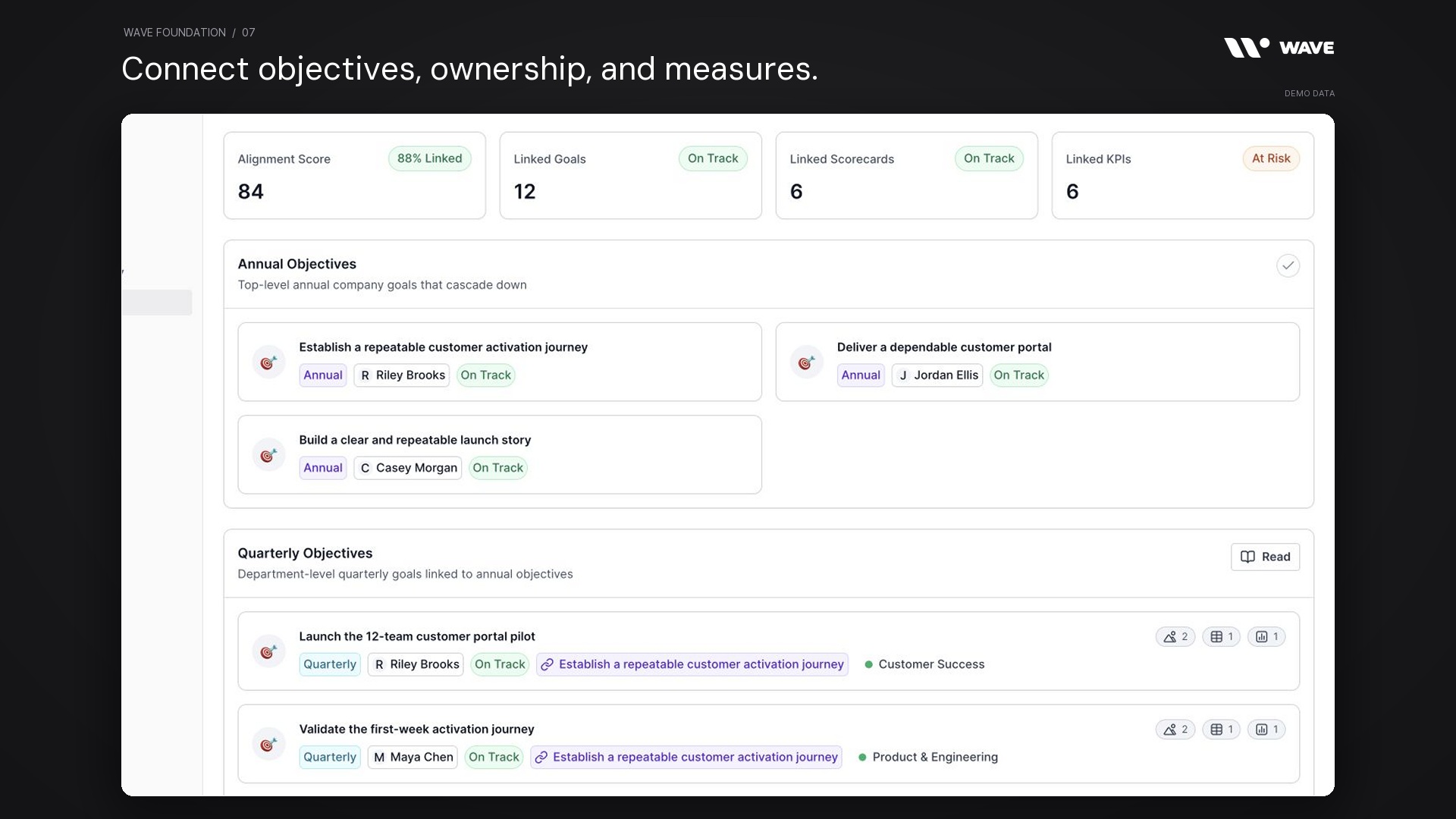
Wave Foundation gives your team a shared view of company direction and the objectives that carry it forward. It brings purpose, customers, strategic choices, economics, long-term direction, and current priorities into a structured plan, then connects that direction to annual and quarterly objectives.
A strategy becomes more useful when people can find it, understand the choices behind it, see who owns the priorities, and connect those priorities to measurable work. Wave Foundation brings those conversations into the same operating workspace as goals, scorecards, and KPIs.
Watch the Wave Foundation product showcase
The 48-second showcase uses actual Wave UI components with a fictional Northstar Studio strategy. The example includes six pillars, all 34 strategic-plan fields, three annual objectives, six quarterly objectives, named owners, illustrative alignment metrics, and reading progress for six teammates. All company details, targets, scores, and results are sample data.

What is Wave Foundation?
Wave Foundation is the company strategy and objectives area in Wave. Its Strategic Plan explains who the company is, whom it serves, how it intends to win, and what matters now. Strategic Objectives carry that direction into annual outcomes and quarterly priorities, with ownership and connections to execution measures.
In the sample, Northstar Studio wants to make the next useful action obvious for small service teams. That direction leads to a focused customer portal pilot. The annual objectives cover customer activation, dependable delivery, and a clear launch story; the quarterly objectives identify the concrete outcomes and people responsible for advancing them.
The six Wave Foundation strategy pillars
1. Identity: who we are and why we exist
The Identity pillar establishes the reasons and behaviors that should endure beyond a particular project. It contains six fields:
- Purpose: why the organization exists beyond making money.
- Belief Statement: the fundamental belief about the market or industry that drives the company.
- Mission: what the organization does to move toward its purpose.
- Passion: what energizes the organization.
- Core Values: the principles that guide behavior and what they look like in practice.
- Cultural Non-Negotiables: the behaviors the company will not accept.
Northstar’s example ties customer clarity to visible ownership and thoughtful delivery. The point is to give teammates language they can use when making a real decision, reviewing a trade-off, or explaining why a contribution mattered.
2. Company & Value: who we serve and why us
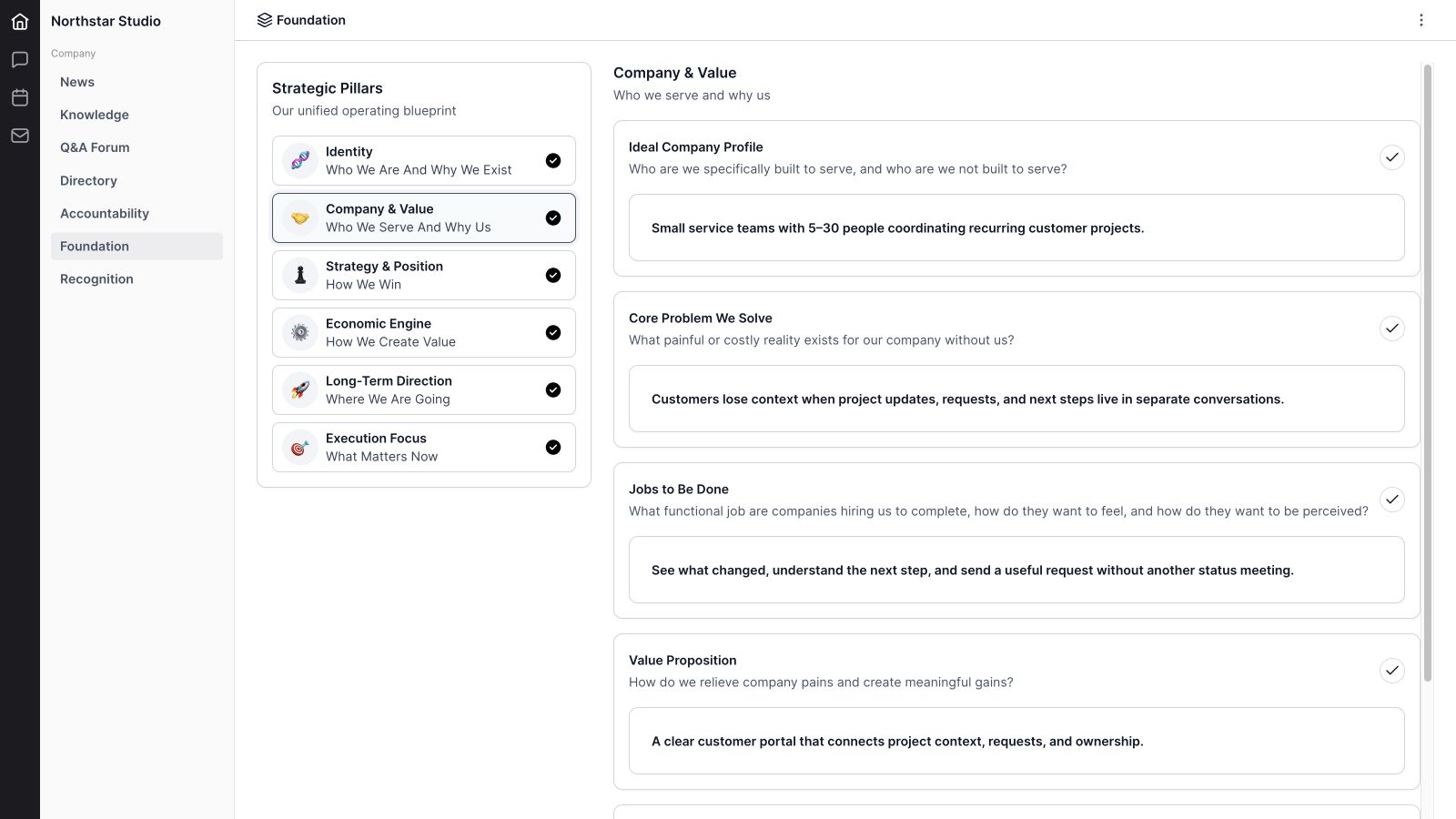
This pillar makes the intended customer and value explicit. Its five fields help connect the company’s work to the customer’s actual problem:
- Ideal Company Profile: the kinds of companies the product is built to serve.
- Core Problem We Solve: the painful or costly reality the customer faces.
- Jobs to Be Done: the functional, emotional, and social outcomes the customer seeks.
- Value Proposition: how the company relieves pain and creates useful gains.
- Brand Promise: what customers should consistently expect.
The sample focuses on service teams with five to thirty people coordinating recurring customer projects. That definition gives the pilot a useful boundary and helps the team evaluate whether a requested feature supports the intended customer.
3. Strategy & Position: how we win
Strategy & Position captures the choices that make the direction specific. Its nine fields cover ambition, focus, differentiation, delivery, and risk:
- Winning Aspiration: what winning means in the market.
- Core Focus: what the organization is built to do exceptionally well.
- Where to Play: the markets, segments, geographies, or channels in scope.
- How We Win: the approach to creating a defensible position.
- 3 Uniques: three meaningful differentiators.
- Proven Process: the repeatable process used to deliver value.
- Strategic Trade-Offs: choices the company deliberately declines to protect focus.
- Sustainable Advantage: what makes the advantage difficult to copy.
- Top Strategic Risks: threats that could undermine the strategy.
For Northstar, the focus is the path from an invitation to a useful first project. Advanced reporting and custom integrations sit outside the first pilot. Recording that trade-off helps the team explain scope decisions using the same strategic context.

4. Economic Engine: how we create value
The Economic Engine pillar makes the business logic and its assumptions visible. It includes six fields:
- Primary Revenue Driver: what drives revenue.
- Profit Engine: where margin is created.
- Economic Driver Metric: the efficiency or leverage measure that reflects the model.
- North Star Metric: a measure of long-term value creation.
- Key Constraints: the limitations that shape the strategy.
- Key Assumptions: what must remain true for the model to work.
These fields explain the reasoning behind the operating plan. The sample identifies recurring active customer teams, repeatable onboarding, and a useful weekly project workflow. Its assumptions remain hypotheses to examine through actual customer evidence.
5. Long-Term Direction: where we are going
Long-Term Direction connects near-term choices to the larger ambition through three fields:
- BHAG: the bold, tangible long-term goal.
- 3-Year Picture: the picture of business success and what the organization looks like at that stage.
- Flywheel: the reinforcing sequence of actions that can compound over time.
Northstar’s example flywheel moves from a clear first outcome to recurring use, better feedback, a stronger product, and referrals. Writing the sequence helps the team discuss which link needs attention instead of treating growth as an unexplained result.
6. Execution Focus: what matters now
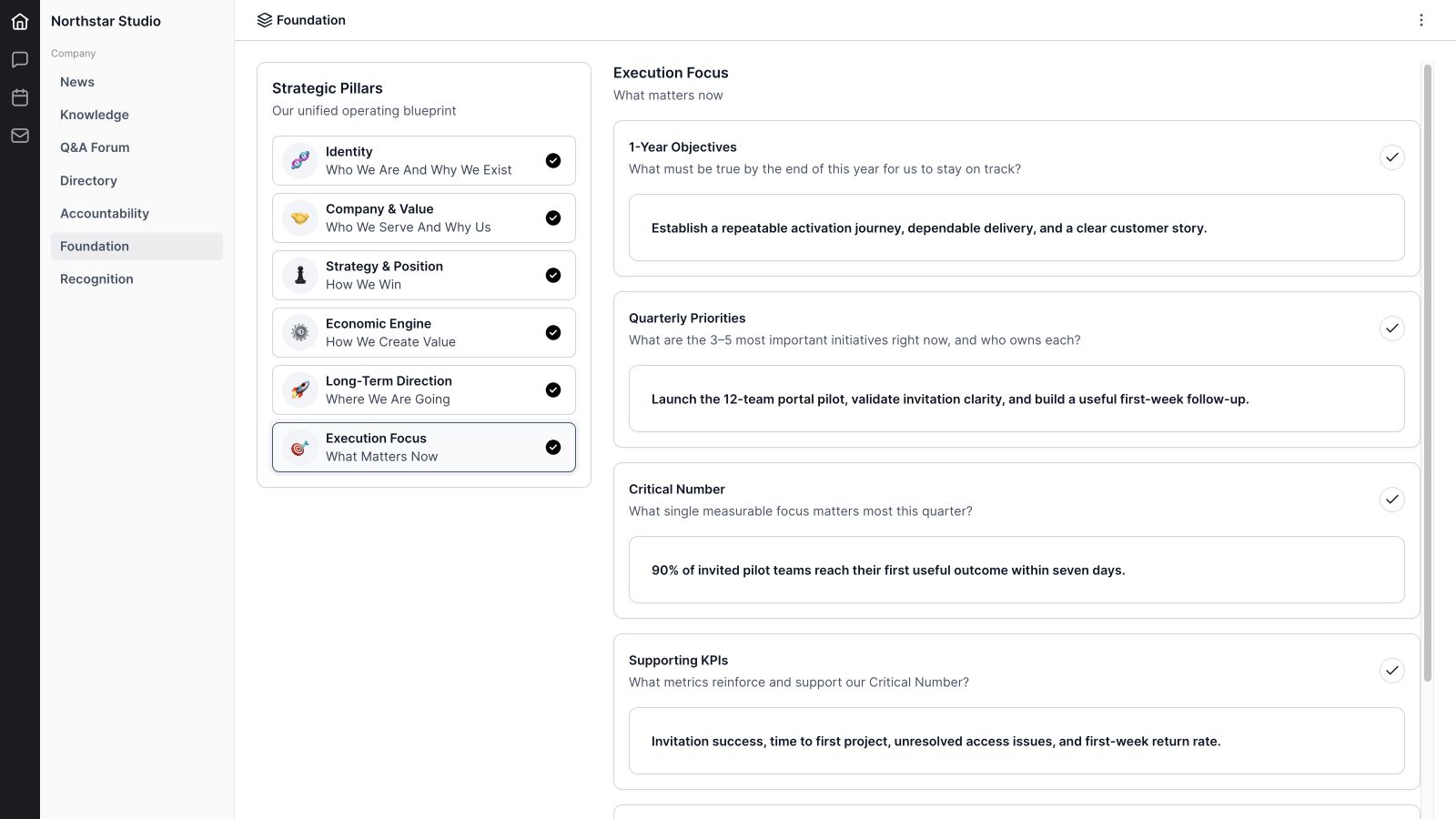
Execution Focus turns the direction into the current operating conversation. It contains five fields:
- 1-Year Objectives: what must be true by the end of the year.
- Quarterly Priorities: the most important initiatives now and their owners.
- Critical Number: the quarter’s central measurable focus.
- Supporting KPIs: measures that reinforce the critical number.
- Key Hypothesis: the assumption currently being tested through action.
The sample critical number is a target: 90% of invited pilot teams reaching a useful first outcome within seven days. It is not a reported customer result. Supporting measures cover invitations, first-project timing, access issues, and return behavior.
Planning, publishing, and reading features
7. A guided structure across 34 fields
Each strategic field includes a question that explains what it is meant to capture. This gives the team a consistent structure for discussing the plan and helps distinguish ideas that are often blended together, such as purpose, mission, value proposition, and competitive approach.
8. Focused field editing
Open a field’s edit action to work on that part of the strategy in its dedicated drawer. The editor keeps the field label, guiding question, existing content, and explanatory hint together. This makes a focused revision possible without losing the surrounding structure of the plan.
9. Core values with practical meaning
The Identity pillar supports a set of core values. Use descriptions that explain observable behavior, such as naming an owner and closing the loop. Specific wording gives teammates something they can apply in decisions, feedback, onboarding, and recognition.
10. A member reading view
The published strategy has a member view designed for reading. Teammates can move between the six pillars and review each field with its guiding question. The pillar navigation keeps the whole plan visible while the reader focuses on one part of the company’s direction.
11. Draft and published states
Foundation distinguishes unpublished content from the plan available to members. Administrative publishing controls let the responsible people prepare the strategy and publish it when ready. Strategic Plan and Strategic Objectives have their own publication states, so the two areas can be managed deliberately.
12. Recorded reading progress
Members can mark strategic fields as read. Completed reading states appear in the plan, and pillar completion helps a teammate see which areas they have covered. This records progress through the material; it does not measure understanding, agreement, or performance.
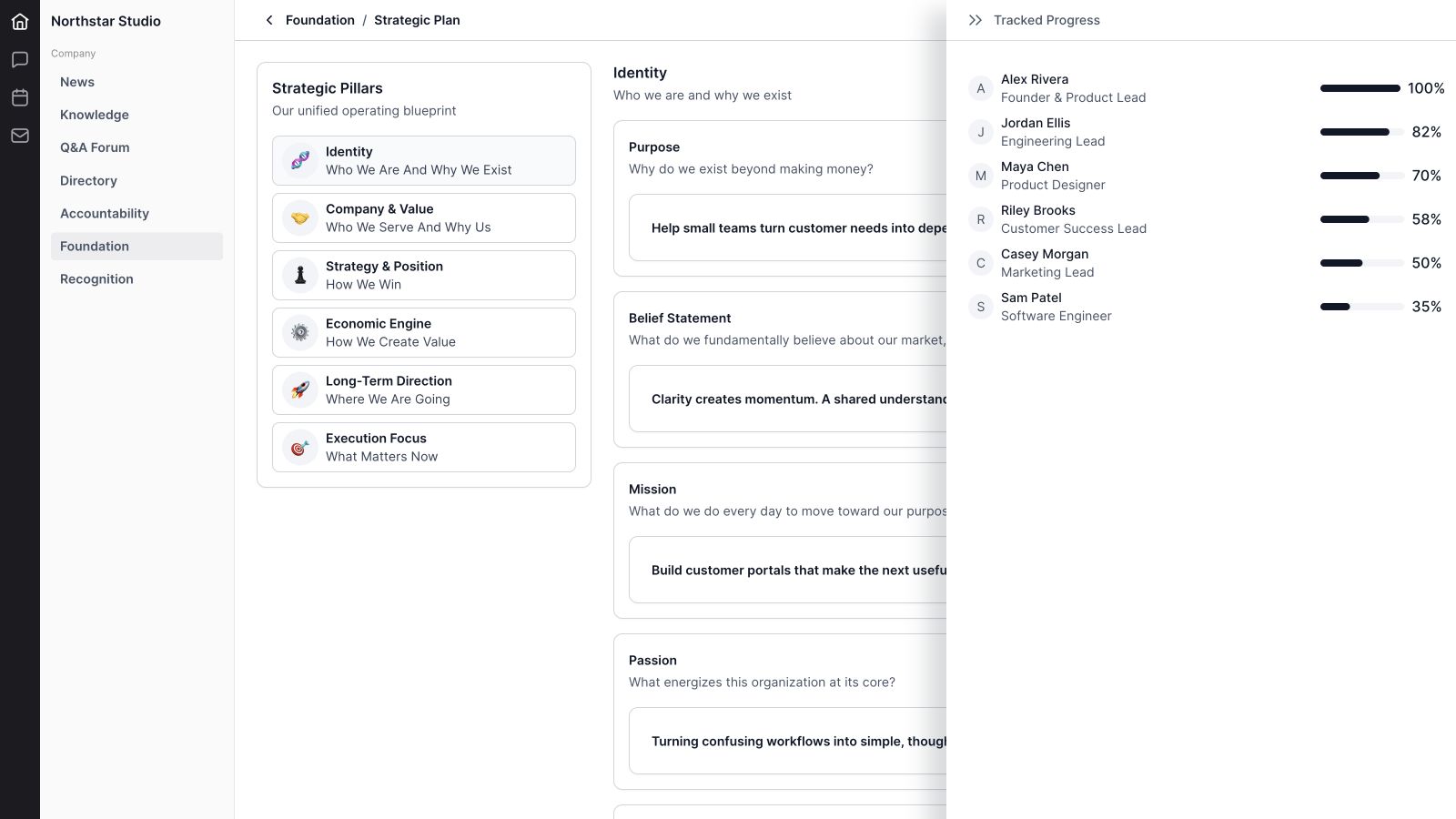
13. Team reading-progress review
The administrative Tracked Progress view lists members and their recorded completion percentages. Use it to identify who may need a reminder or an onboarding conversation. The sample ranges from a fully read plan to partially completed reading, giving a realistic view of rollout progress.
Strategic objectives and execution connections
14. Annual company objectives
Annual objectives capture the top-level outcomes the company is working toward. Each objective has a name, descriptive context, owner, and status. The sample annual outcomes cover customer activation, dependable product delivery, and the launch story, giving the quarterly work a clear strategic parent.
15. Quarterly objectives
Quarterly objectives turn the annual direction into nearer-term outcomes. Name the result the team needs to achieve and add enough description to explain the scope. In the sample, launching the pilot and validating the first-week activation journey are distinct outcomes with different owners.
16. Annual-to-quarterly relationships
Link each quarterly objective to the annual objective it supports. The parent relationship is visible on the quarterly card, helping readers understand why the work matters. This makes it easier to discuss a proposed priority in relation to the company outcome it should advance.
17. Named ownership
Owners appear directly with objectives. A named owner gives the team a clear person to ask about progress, evidence, and the next review. Ownership is especially useful when several functions contribute to the result but one person needs to keep the overall outcome moving.
18. Department context
Quarterly objectives can include a department. This adds organizational context alongside the owner and annual parent. The sample separates Product & Engineering, Customer Success, and Marketing while keeping their work connected to the shared company plan.
19. Objective status
Status indicators make the current state visible on objective cards. A readiness objective marked At Risk can prompt a specific discussion about what is blocking progress. Keep the status grounded in the work and explain the reason in the objective’s supporting context.
20. Objective details and navigation
Open an objective to review its details and available editing controls. Previous and next navigation supports reviewing related objectives in sequence. This gives a planning meeting a practical path from the high-level list into the context behind an individual priority.
21. Alignment and linked-work summaries
The objectives overview includes an alignment score, a linked-work percentage, and counts for linked goals, scorecards, and KPIs. These summaries provide a starting point for reviewing the connections in the operating plan. The sample scores are illustrative, and a strong score still needs meaningful underlying objectives and measures.
22. Links to goals, scorecards, and KPIs
Quarterly objectives expose counts for the goals, scorecards, and KPIs connected to them. The strategic-objective area includes dedicated views for these kinds of linked work. Use those relationships to explain which execution outcomes and measures support a priority rather than leaving the strategy as a separate document.
23. Health summaries and data flow
The objective overview can show health summaries for linked work, such as On Track or At Risk. A data-flow view visualizes the relationships in the strategic-objective system, with pan and zoom controls for exploring the chart. These views help a reviewer investigate the connections behind the summary.
24. Reading acknowledgment for objectives
Strategic Objectives includes reading states for the annual and quarterly sections and a progress view for administrators. This supports communicating a revised plan to the team. Treat acknowledgment as a record of reading and use a conversation when you need to confirm interpretation or commitment.

A practical Foundation rollout
Start with the company choices that guide current work. Draft the six pillars in plain language, make the customer and trade-offs specific, and separate assumptions from verified results. Review the fields with the people responsible for putting the strategy into practice.
Next, create annual objectives and quarterly outcomes with named owners. Link the quarterly work to its annual parent and relevant execution measures. Publish the plan, ask teammates to read it, and use the reading-progress view to guide follow-up rather than assuming publication alone creates alignment.
Revisit Foundation when the evidence changes or the next planning cycle begins. A useful review asks whether the customer definition, strategic choices, assumptions, and current objectives still fit together. Update the written direction and the linked work as part of the same conversation.
How Foundation fits with the rest of Wave
Wave Goals, Wave Scorecards, and Wave KPIs provide the execution and measurement workflows connected to strategic objectives. Wave News helps announce a change in direction, and Wave Q&A Forum gives teammates a place to ask reusable questions about it.
Wave Recognition helps make values concrete through examples of contributions. A useful operating rhythm connects the direction people read, the work they own, the measures they review, and the behavior the company celebrates.
Wave Foundation frequently asked questions
What is Wave Foundation used for?
Foundation holds the company’s strategic plan and strategic objectives. It connects shared direction to annual and quarterly outcomes, ownership, linked work, and recorded reading progress.
What are the six strategy pillars?
They are Identity, Company & Value, Strategy & Position, Economic Engine, Long-Term Direction, and Execution Focus. Together they contain 34 structured fields.
Can we prepare the plan before publishing it?
Yes. Foundation distinguishes draft and published content. Strategic Plan and Strategic Objectives have their own publication states and administrative controls.
How do annual and quarterly objectives connect?
A quarterly objective can link to an annual objective. Its card shows the relationship alongside the owner, department, status, and counts of connected execution items.
Does Foundation connect to goals and metrics?
Yes. Strategic Objectives includes linked goals, scorecards, and KPIs, with counts, summary indicators, dedicated views, and a data-flow visualization of the relationships.
Can we see whether teammates have read the strategy?
Foundation records reading states and provides a Tracked Progress view for the plan. Strategic Objectives also tracks reading of annual and quarterly sections. Reading completion is not a measure of comprehension or agreement.
Are the alignment scores in the demo real results?
No. All scores, linked-work summaries, targets, objectives, and reading progress in the Northstar Studio showcase are illustrative sample data.
How often should a team review Foundation?
Review it as part of planning and whenever important evidence changes the company’s choices. Keep the written direction, quarterly objectives, and supporting measures consistent with the work the team is actually doing.
Give the team a shared direction
Wave Foundation brings company strategy, priorities, ownership, and execution connections into one operating workspace. Get started with Wave and give your team a clear place to understand where the company is going and how its work contributes.


